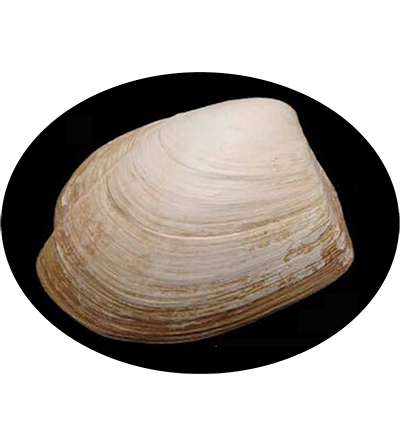
Conchocele bisecta is an extremely large thyasirid very widely distributed in the northern Pacific Ocean, ranging from East China Sea to Russia to Oregon, USA. It is a chemosymbiotic bivalve hosting both methane and sulfur oxidising endosymbionts in a much enlarged gill, and relies on these for energy.
Animalia (Kingdom); Mollusca (Phylum); Bivalvia (Class); Autobranchia (Subclass); Heteroconchia (Infraclass); Euheterodonta (Subterclass); Imparidentia (Superorder); Lucinida (Order); Thyasiroidea (Superfamily); Thyasiridae (Family); Conchocele (Genus); Conchocele bisecta (Species)
Venus bisecta Conrad, 1849
1. Dana J D. United States Exploring Expedition During the Years 1838, 1839, 1840, 1841, 1842 Under the Command of Charles Wilkes, USN: Geology[M]. C. Sherman, 1849. (Dana et al., 1849)
with "bisecta" likely referring to its distinct posterior ridge or "two-part" appearance. The genus name, Conchocele, is Latin-derived from "concha" (shell) and Greek "keleh," meaning to divide or split, which again alludes to a divided or notched aspect of the shell.
Caribbean Sea, Gulf of Mexico
| Species | Phylum | Common Name | Ecosystem | Depth | Habitat | NCBI Taxonomy ID |
|---|---|---|---|---|---|---|
| Conchocele bisecta | Mollusca | deep-sea bivalves | Hydrothermal vent | 50-650 | hydrothermal vents field in the East China Sea (27° 47.5′ N, 126° 53.8′ E) | 1803738 |
| Genome Assembly | Genome Size | Assembly level | Released year | WGS accession | Submitter | BioProject | BUSCO completeness (%) | Scaffold/Contig N50 (kb) | GC content (%) | Repeat Rate (%) | Gene Number |
|---|---|---|---|---|---|---|---|---|---|---|---|
| ASM2923769v1 | 1.9Gb | Chromosome | 2023 | JAQRGA01 | Institute of Oceanology, Chinese Academy of Sciences | PRJNA913320 | 95.40 | 106,900/488.6 | 39.22 | 66.96 | 25,483 |
| Title | Journal | Pubmed ID |
|---|---|---|
| Hologenome analysis reveals independent evolution to chemosymbiosis by deep-sea bivalves | BMC Biology | 36882766 |