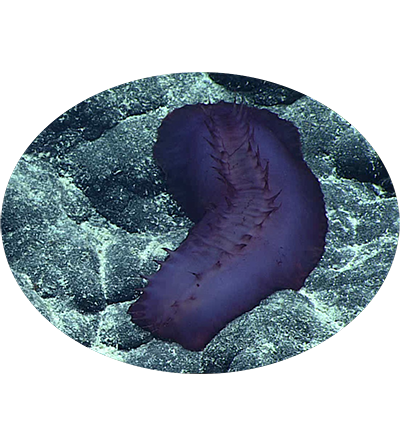
The hadal sea cucumber Paelopatides sp. Yap is a species of hadal sea cucumber in the family Stichopodidae, collected from the Yap Trench in the western Pacific Ocean. This species is adapted to the extreme conditions of the hadal zone, thriving at great depths where pressures are immense and temperatures are near freezing. Its discovery contributes to our understanding of biodiversity and ecological dynamics in one of the least explored regions of the deep sea.
Animalia Kingdom; Echinodermata (Phylum); Holothuroidea (Class); Stichopodidae (Family); Paelopatides (Genus); Paelopatides sp. Yap (Species)
| Species | Phylum | Common Name | Ecosystem | Depth | Habitat | NCBI Taxonomy ID |
|---|
| Paelopatides sp. Yap | Echinodermata | Paelopatides sp. Yap | Deep sea | 6,633 | Yap Trench at 8°1′22"N; 137°50′41"E | - |
| Genome Assembly | Genome Size | Assembly level | Released year | WGS accession | Submitter | BioProject | BUSCO completeness (%) | Scaffold/Contig N50 (kb) | GC content (%) | Repeat Rate (%) | Gene Number |
|---|
| - | 3.7Gb | Contig | 2020 | - | Fujian Agriculture and Forestry University | PRJCA003789 | 89.40 | 137.1 | 38.19 | 76.06 | 57,522 |
| Title | Journal | Pubmed ID |
|---|
| The genome of a hadal sea cucumber reveals novel adaptive strategies to deep-sea environments | iScience | 36444293 |